
Makrell is a structural family for programming languages, data formats, markup formats, and embedded DSLs.
Makrell
Makrell is a family of languages and formats built around a shared structural core. It combines compact syntax, functional flow, metaprogramming, structured data, and markup in one coherent ecosystem.
If most language projects force you to choose between code, data, markup, and host ecosystem fit, Makrell is trying to make those pieces belong to the same world.
The family currently centres on:
MakrellPy, the Python-hosted implementation with the deepest language support.
MakrellTS, the TypeScript and JavaScript-hosted track.
Makrell#, the .NET-hosted implementation for CLR interop, compile/load workflows, and tooling.
MRON, a Makrell-shaped alternative to JSON.
MRML, a Makrell-shaped alternative to XML and HTML.
MRTD, a Makrell-shaped tabular format.
MBF (Makrell Base Format), the shared structural foundation underneath the family.
Makrell is useful when you want more than one thing at once:
one structural model across code, data, and markup
concise functional and operator-oriented syntax
pattern matching and metaprogramming
embedded mini-languages
multiple host ecosystems without giving up a family identity
What you can do here
Use this site in the way that matches your goal:
learn the shared ideas first in Shared Concepts
start building immediately in MakrellPy, MakrellTS, or Makrell#
check the current editor workflow in VS Code Extension
learn by example in Tutorials
solve concrete problems in Cookbook
Playground
The playground is a separate TypeScript app with a real MakrellTS compile/run path, shared editor assets, diagnostics, examples, and integrated docs.
Editor Workflow
If you want the quickest current development experience, start with VS Code Extension or install the published extension from the Visual Studio Marketplace.
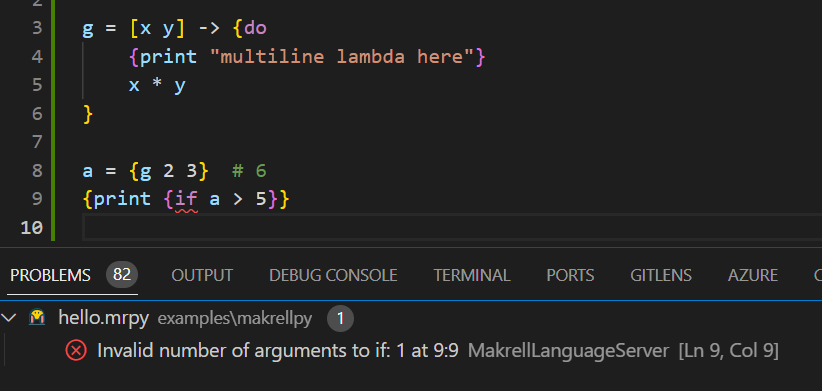
vscode-makrell-omni is now part of the practical front door for the project:
syntax highlighting and snippets for the family
run/check workflow for MakrellPy, MakrellTS, and Makrell#
editor-visible diagnostics for MakrellPy, MakrellTS, Makrell#, MRON, MRML, and MRTD
an optional path toward hover/go-to via
makrell-langserverwhile the broader TS-family tooling path is being built
Quick Taste
Makrell-style code
{fun add [x y]
    x + y}

add3 = {add 3 _}

[2 5 8] | {map add3} | sum
MRON
owner "Rena Holm"
tools ["MakrellPy" "Makrell#" "MakrellTS"]
features {
    macros true
    pattern_matching true
}
MRML
{page
    {hero
        {h1 Makrell}
        {p One family for code, data, and markup.}}
    {section [class="features"]
        {card {h2 Functional} {p Pipes, operators, and composition.}}
        {card {h2 Metaprogrammable} {p Quote, unquote, macros, and mini-languages.}}
        {card {h2 Multi-host} {p Python, TypeScript, and .NET implementations.}}}
}
Start Here
Popular Paths
Want the broadest current language experience? Start with MakrellPy.
Want the TypeScript reference track? Go to MakrellTS.
Want CLR interop and .NET workflows? Go to Makrell#.
Want a compact data format? Start with MRON.
Want compact structural markup? Start with MRML.
Want a simple tabular format? Start with MRTD.
Why Makrell?
Makrell is not just another syntax for one runtime. The central idea is that the same structural model can carry:
a programming language
a data notation
a markup notation
macros and embedded mini-languages
similar idioms across multiple host ecosystems
That makes Makrell useful both as a practical tool and as a language-design platform.
It also makes Makrell feel different from projects that are only:
a syntax experiment
a host-language wrapper
a data format with no language story
a macro system with no broader family structure
Implementation Picture
The Makrell family is developing across multiple implementations. They do not all have the same maturity, but they share the same direction:
MakrellPy: currently the broadest language implementation and the deepest reference point.
MakrellTS: the JavaScript and TypeScript track, important for browser and Node.js integration.
Makrell#: the CLR and .NET track, with growing support for interop, macros, dynamic loading, MRON, and MRML.
The shared concepts pages explain what belongs to the family as a whole. Each implementation section explains what is available in that host today.